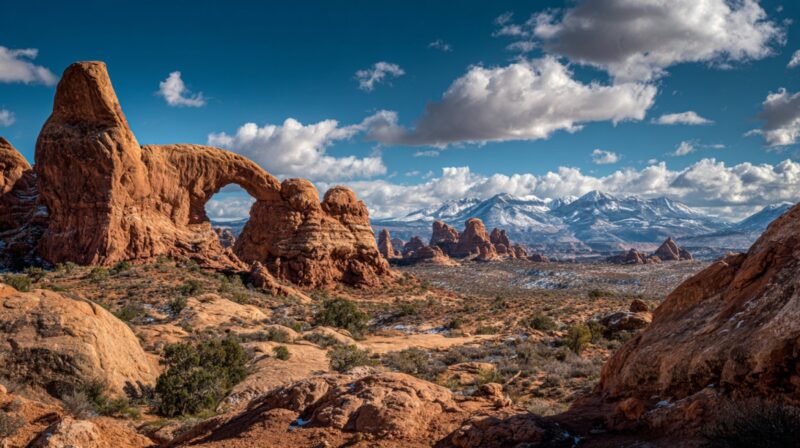
Arches National Park sits near Moab, Utah, protecting more than 2,000 natural sandstone arches shaped across millions of years of erosion and shifting geology.
A relatively small footprint of just over 75,000 acres allows visitors to move easily between hikes, viewpoints, and road-accessible stops without long travel times.
Compact size makes it possible to see a wide range of formations without committing to long backcountry trips.
Most travelers manage to cover the essential sights within one or two days. Early arrival plays a major role in overall experience, since parking areas fill quickly and midday congestion can slow travel through the park. Seasonal access rules also affect planning.
Timed-entry reservations apply between April and October during peak daytime hours, while unrestricted access outside that window favors sunrise and sunset visits when temperatures stay cooler and crowds thin out.
1. Hike to Delicate Arch, the Iconic Symbol of Utah
Delicate Arch remains the most recognizable feature inside the park and even appears on Utah license plates. Reaching it requires a moderately strenuous hike that rewards effort with one of the most famous views in the American Southwest.
- Distance measures 3.2 miles round-trip
- Elevation gain reaches 629 feet
- Open slickrock sections leave hikers exposed to sun and wind
Sunrise draws visitors hoping to avoid crowds, while sunset brings warm color and dramatic shadows across the stone. Arriving at least an hour before sunrise improves chances of securing parking and starting early.
Water, sunscreen, and sturdy footwear matter year-round, while winter conditions often create icy sections that make microspikes a smart addition. A narrow rock ledge near the end challenges visitors sensitive to heights.
Alternative viewpoints allow easier access. Upper Delicate Arch Viewpoint offers a one-mile round-trip walk with a distant perspective. Lower Viewpoint requires no hike and suits families or travelers preferring minimal walking.
2. Explore the Devils Garden Trail
View this post on Instagram
Devils Garden presents the greatest concentration of arches in the park and allows flexibility based on time, ability, and comfort with exposure. Options range between a short walk and a demanding full loop.
- 1.6 miles round-trip leads to Landscape Arch
- 7.9 miles covers the full loop through primitive terrain
Landscape Arch stretches an impressive 306 feet, placing it among the longest natural arches in the world. Additional formations appear along the route, including Pine Tree Arch, Tunnel Arch, Double O Arch, Navajo Arch, Partition Arch, and Private Arch.
Longer routes involve rock scrambling, sandy stretches, and exposed edges. Primitive segments may include muddy pools and narrow ledges that demand careful footing.
Partition Arch delivers a framed view across the park that draws photographers throughout the day.
Devils Garden Parking Lot serves as the starting point and often fills early, especially during peak season.
3. Visit the Windows Section and Turret Arch
Windows Section delivers impressive views with minimal effort, making it ideal for visitors working with limited time or seeking easy walks.
An approachable 1.2-mile loop links several major formations and allows frequent pauses for photos and observation. Paths remain well-defined and mostly flat, encouraging a relaxed pace.
North Window and South Window dominate the area with massive openings that feel almost architectural in scale.
Turret Arch rises nearby with a bold double opening that shifts appearance as sunlight moves across the stone. Light plays a major role in shaping the experience, and timing affects both color and shadow.
Morning and late afternoon produce the most favorable conditions. Cooler temperatures combine with angled light that adds depth and contrast.
A well-known photo opportunity appears behind the North Window, where careful positioning allows the Turret Arch to sit neatly framed within the opening.
The Garden of Eden lies a short distance away and features dramatic rock formations while drawing fewer visitors than nearby stops, offering a quieter extension to the visit.
4. Stand Under Double Arch

Double Arch ranks among the tallest and widest formations in the park and shows a different geological story compared to most arches nearby. A brief walk makes access easy and suitable for a wide range of visitors.
- 0.6 miles roundtrip
- Easy terrain suitable for most visitors
Two massive arches rise side by side and connect at a single base, shaped by downward water erosion rather than side erosion.
Standing beneath the arches emphasizes scale and creates a sense of enclosure that contrasts with the open desert surroundings.
Evening visits draw many photographers, since sunset casts warm color across the stone and deepens shadows along the curved surfaces.
Access begins at the Windows Section parking area and works well for families, casual walkers, and those seeking a short stop.
5. Wander Park Avenue Trail
Park Avenue Trail offers a calmer alternative to the park’s busiest areas while still delivering dramatic scenery.
Towering rock walls line the route and resemble a stone corridor stretching ahead. Distance and elevation remain moderate at 1.8 miles round-trip with roughly 298 feet of gain, making it manageable for most hikers.
Late afternoon improves comfort and visual impact. Cooler air settles into the corridor, and long shadows emphasize height and texture along the rock faces.
Courthouse Towers serves as the starting point, where the trail descends gently toward Park Avenue Viewpoint before reversing course.
Lower foot traffic allows a slower pace and more opportunities to stop, listen, and take in the surroundings without pressure.
View this post on Instagram
6. Experience the Fiery Furnace With a Permit or Guide
Fiery Furnace presents one of the most challenging and immersive areas of the park. Narrow sandstone fins twist into a dense maze that requires careful movement, balance, and navigation.
Distance averages about 1.7 miles, though the exact length varies depending on route choices and detours.
Preparation matters due to the absence of a marked trail. Entry options include ranger-led tours offered between May and September or self-guided permits available on Recreation.gov up to seven days in advance.
Navigation becomes part of the adventure, and losing direction often happens even to experienced hikers.
Scrambling over rock, squeezing through narrow passages, and retracing steps turn movement into a constant decision-making process.
Visitors without permits still have options. Fiery Furnace Viewpoint provides safe access to sweeping views across the maze, allowing appreciation of its complexity without entering the fins.
7. Check Out Balanced Rock
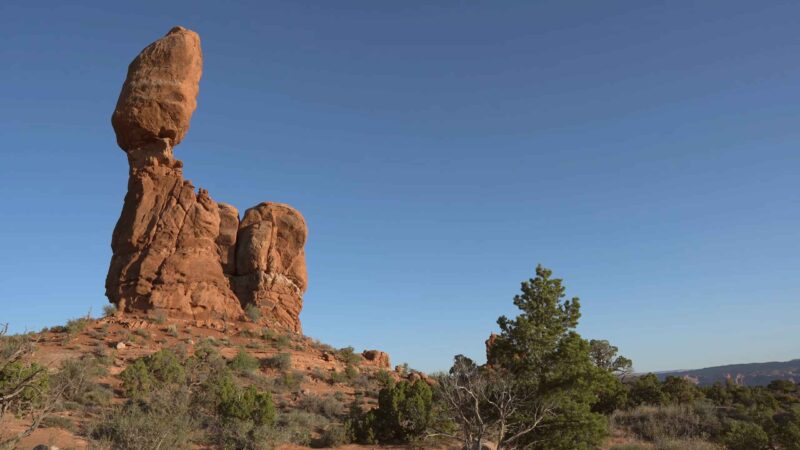
Balanced Rock delivers one of the most recognizable roadside sights in the park and requires very little time to visit.
A towering 128-foot formation supports a 3,600-ton boulder that appears precariously positioned atop a narrower base.
Visual tension comes from harder sandstone resting on softer mudstone that erodes more quickly, creating a striking contrast in form and texture.
A flat 0.3-mile loop circles the formation and suits all skill levels, including families and travelers with limited mobility. Proximity to the Scenic Drive makes the stop convenient for quick photos or a short break between longer hikes.
8. Take the Arches Scenic Drive
Arches Scenic Drive links nearly all major viewpoints and trailheads across a 19-mile route stretching between the Visitor Center and Devils Garden. Pull-offs offer frequent opportunities to stop without hiking.
- La Sal Mountains Viewpoint near the entrance delivers wide views
- Panorama Point attracts sunset watchers with mountain backdrops
- Petrified Dunes Viewpoint reveals hardened layers of ancient sand dunes
- Skyline Arch appears after a short 0.4-mile walk near the road
A nonstop drive takes roughly 45 minutes, while a full-day visit allows time to combine overlooks, short walks, and longer hikes.
@mountainfacts Utah alone contains 43% of all natural rock arches on Earth. But what is it about Utah that makes these unique geologic features so prevalent? Well it’s a unique combination of geology and climate that makes this part of the world virtually perfect for arch formation. What is your favorite rock arch? #educatoraward #learnontiktokcontest #geology #utah #archesnationalpark ♬ original sound – Mountains
Summary
Arches National Park delivers striking geology paired with easy access.
Sunrise hikes to Delicate Arch, scrambles through Fiery Furnace, or relaxed drives along Arches Road each create lasting memories.
Early starts, adequate water, and responsible travel practices help ensure a rewarding visit to this desert environment.

Hello, my name is Harper Barton. The only thing I love more than travelling is writing about it. Sounds strange doesn’t it? But yeah, I adore writing and sharing my experiences about what I have experienced during my travels. Since I am a person who loves being a part of the community, I often write about local festivals with the goal of popularizing outside just small communities they come from.