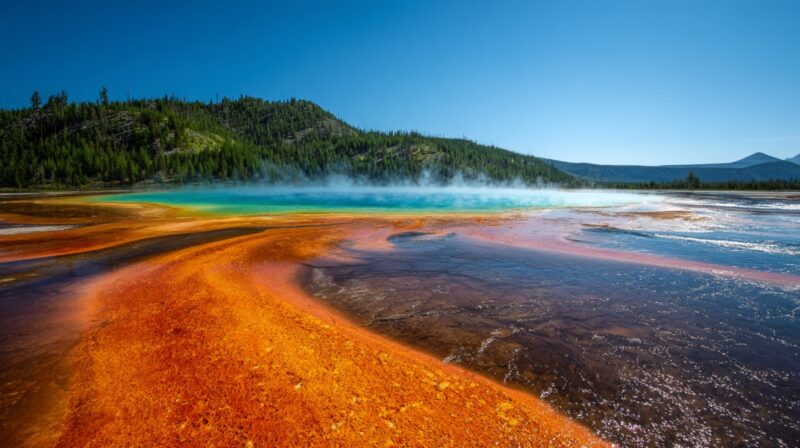
Grand Prismatic Spring ranks as Yellowstone National Park’s most photographed geothermal feature and one of its most visually striking sights.
Located in the Midway Geyser Basin, the spring draws visitors due to its immense size, vivid coloration, and easy access.
Measuring about 370 feet wide and 160 feet deep, it holds the title of largest hot spring in the United States and third largest worldwide, surpassed only by Frying Pan Lake in New Zealand and Boiling Lake in Dominica.
The naming of the spring traces back to the Hayden Geological Survey of 1871, inspired by radiant color bands that resemble a prism. Proximity to Old Faithful, roughly seven miles away, and connection to the Firehole River add context to its setting within Yellowstone’s geothermal corridor.
Location & Getting There
Midway Geyser Basin sits along Yellowstone’s Grand Loop Road, positioned roughly halfway between Madison Junction and Old Faithful. Central placement makes the area easy to combine with several geothermal stops during a single day.
The West Entrance provides the most direct access, located about 24 miles away with an average drive time of 40 minutes under normal conditions. Travel planning often depends on flight availability, driving comfort, and seasonal road access, with several airports serving as practical gateways.
- West Yellowstone Airport with seasonal service connecting Denver and Salt Lake City
- Bozeman Yellowstone International Airport, about 1.5 to 2 hours away by car
- Jackson Hole Airport, requiring roughly two hours to reach the South Entrance via Grand Teton National Park
Parking logistics require advance awareness during busy months.
Midway Geyser Basin parking lot frequently fills after 10:30 AM, leading to wait times of 20 to 30 minutes during peak season. Roadside overflow parking becomes common and demands careful attention to traffic conditions and posted restrictions.
Personal vehicles remain the primary mode of transportation inside the park due to the absence of an internal shuttle system.
Visit timing often works best when allocating one to two hours for boardwalk viewing, with additional time needed for the overlook hike.
The Best Time to Visit
Peak viewing season runs May through September, when road access remains consistent, hiking is comfortable, and color visibility reaches maximum strength. Sun angle plays a major role in color clarity, making certain hours far more favorable than others.
Early mornings and evenings reduce crowd pressure but often introduce heavy steam that partially blocks views, especially on cooler days.
Arrival timing before 9 AM or after 5 PM significantly reduces parking congestion and boardwalk traffic.
Winter conditions restrict access to guided snowmobile or snowcoach tours departing West Yellowstone or Jackson Hole, as private vehicles are not permitted.
Elevation near 8,000 feet contributes to cool mornings even during summer months, making layered clothing a practical choice throughout the season.
Experiencing the Grand Prismatic Up Close
A wooden boardwalk loop measuring approximately 0.8 miles provides close-range access through Midway Geyser Basin.
Flat terrain and minimal elevation change allow comfortable movement for wheelchairs and strollers. Environmental conditions vary daily, with sulfuric odors and dense steam appearing more frequently on cooler mornings.
Visitor safety depends on strict adherence to posted rules, as fragile ground crust near thermal features can collapse without warning.

- Remaining on designated boardwalks at all times
- Avoiding dropped items due to strong winds
- Respecting pet restrictions, as animals are not permitted
Several nearby geothermal features add depth to the walk and reward slower pacing.
Excelsior Geyser Crater discharges more than 4,000 gallons per minute at roughly 199°F, Opal Pool displays occasional eruptions, and Turquoise Pool spans about 100 feet with temperatures ranging between 142°F and 160°F.
Photography conditions improve during bright midday light, when the contrast between the orange microbial mats and the deep blue center becomes more pronounced.
Viewing the Grand Prismatic From Above
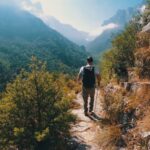
Grand Prismatic Overlook Trail provides the clearest vantage point for viewing the entire color spectrum in one frame. Trail access begins at Fairy Falls parking area, located five minutes south of Midway Geyser Basin.
- Distance of 1.2 miles round-trip
- Elevation gain of about 105 feet
- Average hiking time of 20 to 30 minutes
View this post on Instagram
Trail design features a wide gravel surface with a moderate incline, allowing most visitors to reach the overlook in fair weather conditions.
A fork along the route directs foot traffic toward the overlook on the left or Fairy Falls on the right, where a 200-foot waterfall awaits those continuing onward. Footwear with good traction improves comfort on loose gravel sections.
Clear, sunny conditions between midday and early afternoon deliver the strongest visibility.
Photography works best with wide-angle lenses, while drone use remains prohibited throughout the park. No restrooms or shaded areas exist along the trail, making water and sun protection essential.
Where to Stay
Accommodation planning plays a major role in shaping the overall visit due to limited availability and high demand.
Inside the park, options include historic inns and modern lodges, though most operate seasonally and require reservations six to twelve months in advance.
View this post on Instagram
- Old Faithful Snow Lodge & Cabins – Open mid-December through early March, accessible exclusively by guided oversnow travel. This lodge offers a cozy, rustic winter experience near Yellowstone’s most famous geyser.
- Mammoth Hot Springs Hotel & Cabins – Typically open year-round or reopening in mid-December following seasonal maintenance, providing convenient access to the northern section of the park and wildlife-rich areas like Lamar Valley.
Camping remains available across twelve campgrounds, five of which accept reservations, including:
- Bridge Bay
- Canyon
- Fishing Bridge
- Grant
- Madison
RV travelers must verify length limits prior to arrival, as restrictions vary by campground.
Outside the park, lodging offers broader availability and price flexibility. West Yellowstone serves as the closest and most popular lodging hub, located just 10–15 minutes from the park’s West Entrance and offering a wide range of hotels, cabins, and dining options that remain open year-round.
Gardiner, near the North Entrance, provides convenient access to Mammoth Hot Springs and winter routes that stay open even when most park roads are closed. Cody and Cooke City serve travelers focusing on the park’s eastern and northeastern areas, though access may be limited during the snowy months.
Reservation windows typically open May 1st for the following summer season, making early planning critical. Cost-conscious travelers often select West Yellowstone for its balance of proximity, services, and availability, especially valuable during peak summer months when in-park lodging books up quickly.
View this post on Instagram
Summary
Grand Prismatic Spring combines vibrant color, geothermal science, and visitor access into one unforgettable Yellowstone experience.
Allowing two to three hours enables time for both the boardwalk loop and the overlook hike. Early arrivals, patience during busy periods, and respect for geothermal features enhance the visit.
Pairing the stop with nearby attractions such as Old Faithful, Fairy Falls, and Biscuit Basin fills an entire day of geothermal sightseeing.
Views at ground level and above reveal a rainbow palette that remains one of Yellowstone’s most memorable sights.

Hello, my name is Harper Barton. The only thing I love more than travelling is writing about it. Sounds strange doesn’t it? But yeah, I adore writing and sharing my experiences about what I have experienced during my travels. Since I am a person who loves being a part of the community, I often write about local festivals with the goal of popularizing outside just small communities they come from.